 English
 Nederlands
How to attract starters in Life Sciences?
Starters in Life Sciences often have more to offer than their CV shows at first glance. They have recently completed […]

We offer services for both clients and job seekers. Make your selection above so that we can offer you the right experience.

"My terms of employment were really well arranged"
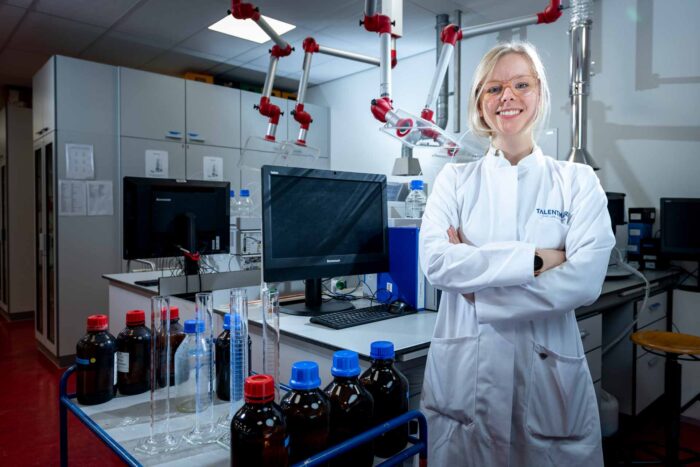
As associate scientist, Sibel Yildiz feels totally at home at MSD Animal Health. Serological and molecular testing for diseases in animals is totally up her street. Recently, she got a permanent contract at MSD, but for the first five years she was seconded via XDES, now Talentmark Hoofddorp. “My terms of employment were really well arranged. In my department, I’m well known for recommending secondment via Talentmark to everyone.”

After my Higher Professional Education in Applied Science, graduating in Science and Life, I spent eighteen months doing molecular diagnostics at Jeroen Bosch Hospital. I knew there was no possibility of a permanent job there at the time. So, I was looking around at other positions. On my LinkedIn account, I’d posted that I was ready for a new challenge. Within a few weeks, XDES contacted me asking if I’d be interested in a job at MSD Animal Health. A day later, it was all sorted.
I was very satisfied with my permanent contract with Talentmark.
At the time I was graduating, I went to a trade fair in the RAI Amsterdam where I talked to a recruiter from XDES. At the time, XDES didn’t have many vacancies in Life Sciences, but we had such a nice conversation that I decided to register. After that, we had regular contact. I always thought that I might get a job via XDES at some point. So, I was delighted that this was the case for my second job as a researcher.
As associate scientist, I do all kinds of routine diagnostic testing, including serological and molecular testing. My work involves testing for antibodies, toxins or microorganisms in different animal materials. The tests I do mainly involve pigs, cows and chickens. I work most with ELISA and PCR tests. These are techniques with which you can show antibodies, toxins and microorganisms in various animal products, including serum, saliva and faeces. One disease I test for cows is the Bovine Corona virus. This involves identifying the antibodies from serum, colostrum or milk. I mainly test pigs for Lawsonia intracelluraris, a bacterial infection common worldwide which causes diarrhoea. The DNA is purified from the faeces and then used for the PCR test. After the PCR test, the results are analysed. Based on these analyses, values are generated. Using these values, you can then see whether the pigs are infected with the bacteria or not. I also test whether a vaccination of a group of pigs has had an effect after a certain period. At the same time, antibodies are also established for various diseases. Vets then study these results and decide whether these animals need the vaccination. We also contribute internally to requests from the research group. Again, the animals are screened to see whether a vaccine is working, for example.
Well, it wasn’t that long. Many of my colleagues work for MSD Animal Health via a recruitment or temporary job agency. I was guaranteed that I could work for MSD via XDES so long as my position existed. In the meantime I have been given a permanent contract. I’m obviously delighted, but I was also very happy with my permanent contract with XDES. And with respect to terms of employment, everything was very well arranged. Whether it concerned holidays, a pay rise, travel expenses or if I was ever ill, our contact was always pleasant and constructive.
Sometimes. I’ve said I’d like to focus more on molecular techniques, because I’m interested in molecular diagnostics. And because more is expected of you at analytical level as a researcher. I have more and more knowledge and experience to be able to take this step. In the long term, I hope to work on projects, where you are more responsible for finding an answer to a research question. Preferably then with research involving people, because then you can help improve the treatment of diseases. But I’m not there yet. I’m very happy and satisfied with my current work.
Starters in Life Sciences often have more to offer than their CV shows at first glance. They have recently completed […]
According to a poll on the LinkedIn account of Talentmark, work atmosphere, team and work-life balance are the factors that […]

From Juni 2026, employers within the EU will be required to share salary information before the interview stage. However, salary […]