 English
 Nederlands

Talentmark Ranks Among the World’s Top 25 Recruitment Firms According to Forbes
Talentmark has been recognised as one of the best recruitment firms in the world. In the Forbes World’s Best Recruiting […]

We offer services for both clients and job seekers. Make your selection above so that we can offer you the right experience.
GMP as the foundation for quality in a regulated environment
If you work in the Life Sciences industry, you are likely to come across the term GMP quite quickly. Knowledge of GMP is also regularly listed as a requirement in job vacancies for professionals looking to work within Life Sciences. But what exactly is GMP? In this article, we explain what GMP means, which GMP guidelines apply and why knowledge of GMP is important for professionals working in Life Sciences.
The abbreviation GMP stands for Good Manufacturing Practice. GMP is a quality system consisting of rules and guidelines for the production and control of medicines and active pharmaceutical ingredients.
Working according to GMP means that an organization’s final product must meet the required quality standards. At the same time, the process used to manufacture that product must be controlled, monitored and documented. The Dutch Health and Youth Care Inspectorate (IGJ) describes GMP as an international system for ensuring quality. Manufacturers of medicines and active substances for human use in the Netherlands must comply with these requirements.
GMP therefore covers the way employees are trained, materials are used, equipment is maintained, production activities are carried out and results are documented.
Within Life Sciences, organizations work on products that can directly affect human and animal health. It is therefore essential that, for example, a medicine is produced in a controlled and consistent way every single time. This is where GMP plays an important role.
According to the European Medicines Agency (EMA), medicines manufactured for the European market must comply with European GMP requirements. One of the main objectives is to ensure that medicines are consistently of high quality, are suitable for their intended use and comply with the requirements of the marketing authorization or clinical trail authorization. Working according to GMP helps, among other things, to:
GMP therefore makes processes traceable, controlled and reproducible. If something deviates during the production process, it must be possible to determine what happend, which batches may have been affected and which actions are required.
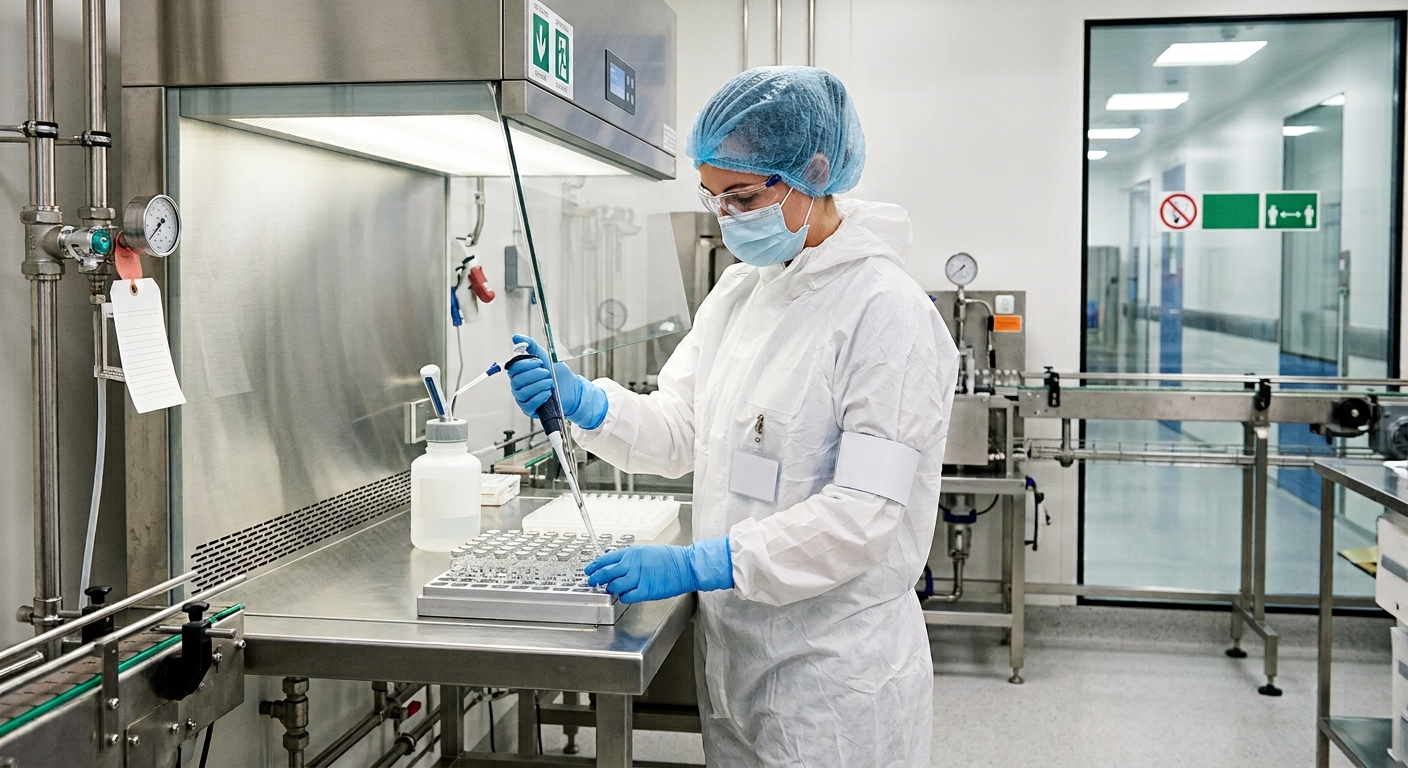
In practice, working according to GMP means that tasks are carried out in a consistent, controlled and demonstrable way. What this involves exactly depends on the role. An operator on the production floor, for example, works according to established procedures and records production activities. A QC Analyst carries out analyses according to approved methods. A QA professional reviews, among other things, deviations and quality processes.
Anyone working in a GMP environment will quickly notice that documentation is an important part of daily work. Production steps, checks and results are recorded so that it is clear afterwards what was done, by whom and when. If something does not go as expected, it cannot simply be ignored. A deviation must be reported, documented and, where necessary, investigated according to the applicable procedure. Hygiene, clothing requirements, access rules, training and the correct use of equipment can also all form part of working according to GMP.
This requires professionals to be accurate, disciplined and quality-conscious. After all, even a small action can form part of a much larger production or quality process.
For professionals who want to work in the pharmaceutical or biotechnology industry, knowledge of GMP can be highly valuable. Many production, laboratory and quality roles are carried out within a regulated environment.
If you already understand what GMP means, why documentation is important and what it is like to work according to established procedures, you have a strong foundation for taking a step into Life Sciences. No GMP experience yet? That does not automatically mean that a career move is impossible. Experience gained in other environments can also provide relevant skills, such as working accurately, carrying out checks or following procedures. Specific GMP knowledge can then be developed further through training and practical experience.
Talentmark specializes in connecting organizations and professionals within Life Sciences. Curious which roles match your education and experience? Take a look at our current vacancies or get in touch with Talentmark. We are happy to help you explore your next step.
Talentmark has been recognised as one of the best recruitment firms in the world. In the Forbes World’s Best Recruiting […]
2026 has already brought a wave of exciting scientific discoveries and technological advancements around the world. From groundbreaking medical treatments […]

Established in 1971, we’re celebrating 55 years of supporting scientific innovation across the life sciences and chemical industries through specialist […]